What is v0 by Vercel exactly?
v0 Definition
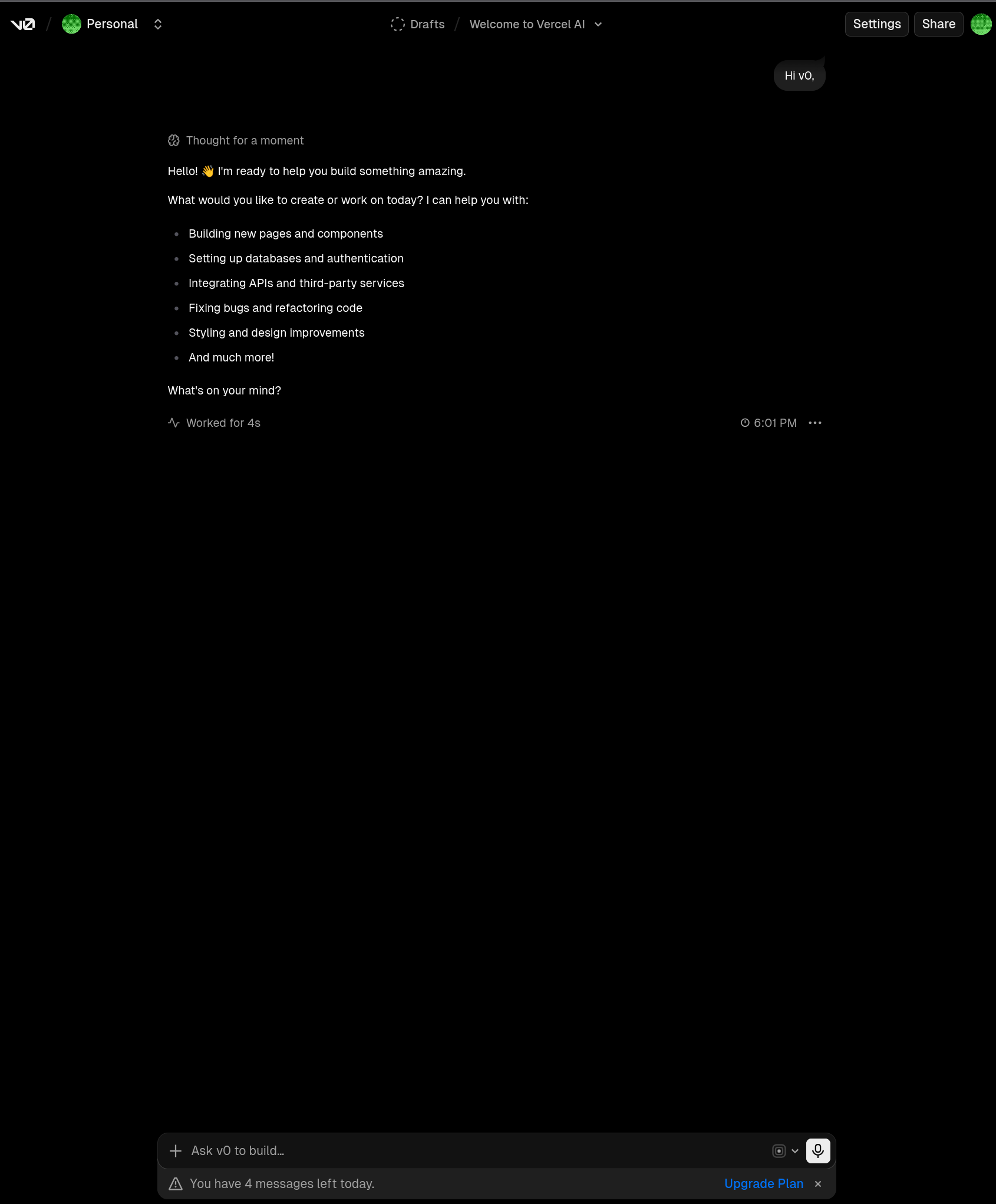
v0 is a code generation system from Vercel that turns natural language prompts into real, working code. Describe what you want — a dashboard, a signup flow, a full marketing site — and it generates production-ready React and Next.js output with Tailwind CSS styling. It handles frontend UI, backend logic, database integrations, and even deploys to Vercel's infrastructure. Read more: why v0 is a harness, not an agent →
Who it's for: developers who want to move faster, non-technical founders prototyping ideas without hiring, and teams shipping internal tools without burning sprint cycles. If you can describe it, v0 can build a working first version of it.
🧱 What Can You Build with v0?
SaaS Dashboards
Admin panels, analytics views, data tables with filters — wire them to real APIs after export.
Marketing Sites
Landing pages, pricing tables, blog layouts — shipped with Tailwind CSS and SEO-ready markup.
Internal Tools
CRUD apps, approval workflows, team dashboards — the kind of tools that used to take a sprint, built in an afternoon.
Prototypes & Demos
Investor demos, design proof-of-concepts, hackathon projects — go from idea to interactive prototype before the meeting ends.
Build Your First v0 Project in 5 Minutes
Free tier available. No credit card. Describe what you want and v0 generates production-ready React code instantly.
v0 vs the Alternatives
| v0 | Bolt | Replit |
|---|---|---|
| Best for React/Next.js | Full-stack scaffolding | Built‑in IDE + deploy |
| Vercel ecosystem | StackBlitz infra | Replit infra |
| Free tier available | Free tier available | Free tier available |
Full comparison of 8 alternatives → · Deep dive: v0 vs Bolt vs Replit →
🚀 Core Platform Architecture & Capabilities
Prompt → Running App
v0 operates as an end-to-end development workspace. You prompt, it generates. You iterate with natural language — "make the sidebar darker," "add a filter to that table" — and the code updates in real time. It functions like an AI pair programmer optimized for Next.js and the modern React ecosystem.
Built-in Backend & Data
Beyond UI generation, v0 scaffolds forms, databases, and API routes inside its sandbox runtime. It integrates with Postgres, handles authentication patterns, and connects to external services like AWS or Snowflake. You get a working full-stack prototype, not just a component screenshot.
Composite Model Architecture
v0's composite model family chains multiple AI models — a retrieval system for up-to-date docs, frontier LLMs for code generation, and an AutoFix layer that automatically catches and resolves errors. This harness architecture produces more accurate output than any single model alone. How the harness works →
🔄 Developer Workflow Integration
GitHub Sync & Version Control
Connect your repository and v0 pushes generated code directly to a branch. Each chat session maps to its own branch, and you can open pull requests to merge into main — no copy-pasting, no manual file management. This is the workflow that makes v0 practical for real team delivery.
Design Import & Iteration
Import designs from Figma or upload screenshots as reference. Switch between design preview mode and code view in separate tabs. Changes auto-save as you iterate, so you never lose progress.
Pricing & Plans
Free tier available with monthly credits. Paid plans use token-based billing across three model tiers — Mini (fastest, cheapest), Pro (balanced), and Max (highest quality). Team and Enterprise plans add SSO, admin controls, and higher rate limits. Full pricing breakdown →
💡 What v0 Can't Do (Yet)
It's Not a Human Developer
v0 generates impressive starting points, but production apps still need human review. Security configurations, authentication logic, database schema design, and error handling require an experienced developer to validate. Think of v0 as an accelerator — it gets you 80% of the way, not 100%.
LLM Hallucination & Token Burn
Like all LLMs, v0 can occasionally generate incorrect code, invent nonexistent APIs, or get stuck in loops — consuming credits each iteration. The composite model family reduces this significantly (93.87% error-free rate), but the remaining ~6% still needs a human eye. If output quality degrades mid-session, start a fresh chat. 10 tips to avoid token waste →
Best with Next.js, Less So Elsewhere
v0 is optimized for Next.js + React + Tailwind CSS. It can generate code for other stacks, but quality and consistency drop. If your project is outside the Vercel ecosystem, tools like Bolt or Replit may be a better fit — see our comparisons →
Next Steps
📅 How v0 Evolved
v0.dev launches
Debuts as an AI UI component generator — prompt → React component with Tailwind CSS.
Backend & database support
Adds sandbox runtime, Postgres integration, API route generation, and multi-file project support.
Vercel raises $9.3B
Series F round — v0 cited as a key growth driver alongside Vercel's AI Cloud strategy.
Rebrands to v0.app
Domain change signals strategic shift — from developer tool to full-stack development platform. Composite model family introduced.
v0 Max tier + iOS app
v0 Max debuts for highest-fidelity generation. iOS app launches — build and ship mobile sites from your phone. Vercel Workflows hits GA with 200K+ npm weekly downloads.
6M+ developers, 80K+ teams, agentic by default
v0 drives 6% of all agent-initiated Vercel deployments. Agentic workloads carry 59% of all token volume on Vercel (up 2x in 6 months).
By the Numbers
Data sourced from Vercel public reporting, analyst estimates, and published benchmarks.
error‑free output rate (vs Claude 4 Opus 78.43%, GPT‑4.1 58.82%)
Source: Vercel composite model benchmarks, 2025
teams building with v0 globally (as of Jan 2026)
Source: Vercel public reporting, Jan 2026
estimated ARR, ~21% of Vercel total (latest public estimate, early 2025)
Source: DevGraphiq, multiple analyst estimates
Series F, September 2025 — v0 cited as key growth driver
Source: Reuters, BusinessWire, Vercel blog
of all agent-initiated Vercel deployments come from v0 — up 1,000% from six months prior
Source: Vercel Agentic Infrastructure report, Apr 2026
Launched September 2023. Rebranded from v0.dev to v0.app in January 2026. May 2026: v0 Max tier rolls out, iOS app launches, Workflows hits GA. Evolved from UI component generator to full-stack, multi-model development platform with agentic infrastructure.
Ready to Ship Faster?
v0 turns prompts into production-ready React code. Start free, iterate with natural language, and push to GitHub in one click.